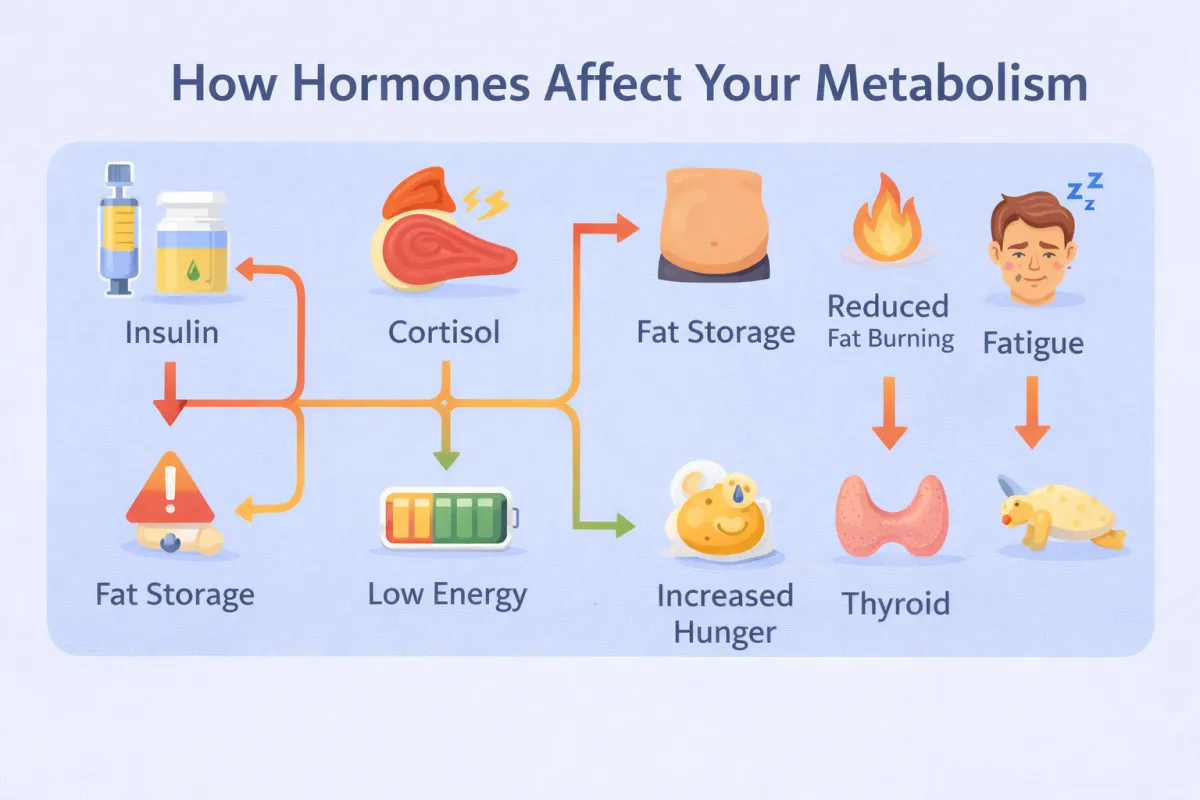
How Hormones Affect Your Metabolism
How Hormones Affect Your Metabolism
Introduction
Hormones play a central role in regulating how the body produces energy, stores fat, and responds to food intake.
While many weight loss strategies focus on calorie balance, hormonal signaling often determines how those calories are used within the body.
When hormonal systems are functioning properly, energy levels are stable and fat can be efficiently used as fuel.
When these systems become disrupted, fat loss may slow, and energy regulation can become less predictable.
What Hormones Actually Do
Hormones act as chemical messengers that coordinate communication between different systems in the body.
They regulate processes such as:
blood sugar control
appetite and hunger signals
fat storage and fat burning
stress response
energy production
Rather than operating independently, these systems work together to maintain metabolic balance.
Key Hormones That Influence Metabolism
Several hormones play a significant role in metabolic function.
Insulin
Insulin regulates blood sugar levels and helps transport nutrients into cells.
When insulin levels are stable, the body can effectively use both carbohydrates and stored fat for energy.
When insulin remains elevated, the body may prioritize fat storage and reduce fat-burning efficiency.
Cortisol
Cortisol is a stress hormone that helps the body respond to physical and psychological stress.
In the short term, cortisol can increase energy availability.
However, when cortisol remains elevated for extended periods, it may contribute to:
increased fat storage
reduced recovery
disrupted energy levels
Leptin and Ghrelin
Leptin and ghrelin regulate hunger and satiety.
Leptin signals fullness, while ghrelin stimulates hunger.
When these hormones become dysregulated, appetite control can become inconsistent, making it more difficult to manage energy intake.
Thyroid Hormones
Thyroid hormones influence metabolic rate and energy production.
When thyroid function is optimal, the body maintains consistent energy output.
When impaired, metabolic processes may slow, contributing to reduced energy levels and slower fat loss.
Hormonal Imbalance and Fat Loss Resistance
Hormonal imbalance does not typically occur in isolation.
It is often the result of multiple factors, including:
chronic stress
poor sleep
long-term calorie restriction
lack of recovery
When these factors accumulate, hormonal signaling may become less efficient.
This can lead to:
difficulty losing weight
increased fat storage
energy fluctuations
persistent fatigue
The MOS Perspective
Within the Metabolic Operating System framework, hormones are part of a broader system known as Hormonal Signaling.
This system works alongside:
Fuel Utilization
Metabolic Flexibility
Recovery and Energy Regulation
When hormonal signaling becomes impaired, it affects how the body processes energy and determines whether fat is stored or used as fuel.
This can contribute to a state of metabolic protection mode, where fat loss becomes more difficult.
Why Calories Alone Don’t Tell the Full Story
While calorie balance is a factor in fat loss, it does not fully explain how the body responds to food.
Hormones influence:
how calories are stored
how energy is released
how hunger is regulated
Two individuals consuming the same number of calories may experience different outcomes depending on their hormonal state.
Supporting Healthy Hormonal Function
Improving hormonal signaling is not about targeting a single hormone.
It involves supporting the systems that regulate metabolic balance.
This may include:
improving sleep quality
managing stress levels
stabilizing meal timing
supporting recovery
When these systems are functioning well, hormonal signaling tends to improve naturally.
Evaluating Hormonal Signals
Understanding how hormonal systems are functioning can help identify potential metabolic bottlenecks.
Rather than guessing, a structured assessment can provide insight into:
energy regulation
hunger patterns
fat storage tendencies
recovery capacity
The Metabolic Self Test is designed to evaluate these patterns.
👉 Take The Metabolic Self Test
Final Thoughts
Hormones play a fundamental role in how the metabolism functions.
They influence how energy is produced, stored, and used throughout the body.
When hormonal signaling becomes disrupted, fat loss can become more difficult and energy levels may become inconsistent.
By understanding how hormonal systems interact with metabolism, it becomes possible to address the underlying factors that influence metabolic health.


