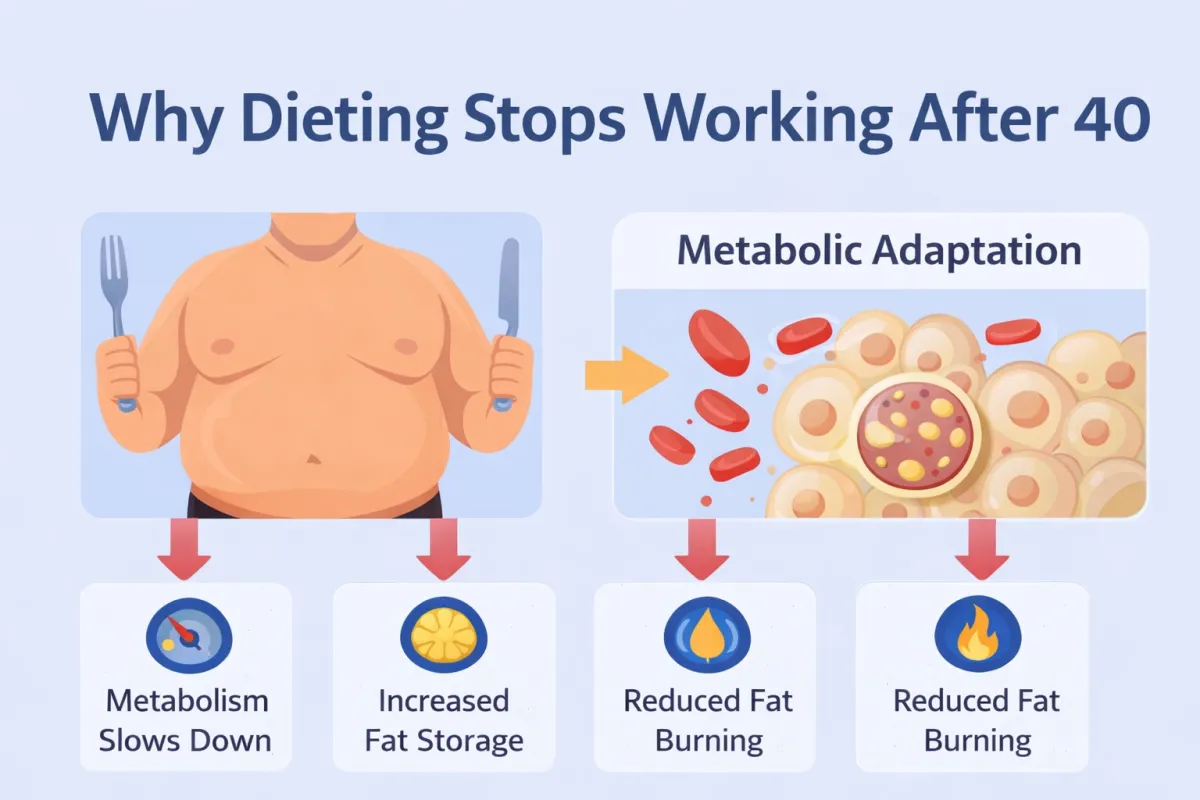
Why Dieting Stops Working After 40
Why Dieting Stops Working After 40
Introduction
Many people notice that dieting becomes less effective as they get older.
Strategies that once led to consistent weight loss—such as reducing calories or increasing exercise—begin to produce slower results or stop working altogether.
This is often interpreted as a lack of discipline or consistency.
However, in many cases, the underlying issue is not effort, but a change in how the metabolism is functioning.
The Traditional Approach to Fat Loss
Most weight loss programs are based on a simple principle:
Eat less, move more.
In the short term, creating a calorie deficit can lead to weight loss. The body is forced to use stored energy, which results in a reduction in body fat.
However, this model assumes that the body will continue to respond the same way over time.
In reality, the metabolism adapts.
Metabolic Adaptation
The human body is designed to preserve energy.
When calorie intake is reduced over a prolonged period, the body responds by becoming more efficient.
This process, often referred to as metabolic adaptation, can result in:
reduced energy expenditure
increased hunger signals
decreased fat-burning efficiency
greater reliance on stored energy
Over time, the same diet produces fewer results.
Why This Becomes More Pronounced After 40
After the age of 40, several physiological changes can influence how the metabolism responds to dieting.
Loss of Muscle Mass
Muscle tissue plays a key role in energy expenditure.
As muscle mass decreases, the body requires fewer calories to function, which can contribute to a slower metabolic rate.
Hormonal Changes
Hormones such as insulin, cortisol, and testosterone influence how the body stores and uses energy.
Changes in these systems can alter fat storage patterns and reduce the efficiency of fat burning.
Reduced Metabolic Flexibility
The body may become less efficient at switching between energy sources.
This can lead to a greater dependence on glucose and a reduced ability to access stored fat.
The Dieting Response
When weight loss slows down, the most common response is to further reduce calories or increase activity.
While this may produce short-term results, it can also reinforce the metabolic adaptations that are already occurring.
The body may continue to:
conserve energy
increase hunger
reduce output
This creates a cycle where more effort produces diminishing returns.
The MOS Perspective
Within the Metabolic Operating System framework, this is not viewed as a single issue.
Instead, it reflects changes across multiple metabolic systems:
Fuel Utilization
Hormonal Signaling
Metabolic Flexibility
Recovery and Energy Regulation
When these systems become impaired, the body may shift into a state referred to as metabolic protection mode.
In this state, fat loss becomes more difficult, and energy regulation becomes less stable.
Why Dieting Alone Is Not Enough
At this stage, continuing to focus only on calorie reduction may not address the underlying issue.
The challenge is no longer simply how much energy is being consumed, but how the body is processing and regulating that energy.
Without addressing the metabolic systems involved, fat loss may remain limited.
Evaluating Metabolic Function
Understanding which metabolic systems are contributing to reduced fat loss is an important step.
Rather than relying on trial and error, a structured assessment can help identify patterns related to:
energy regulation
hormonal signaling
fat utilization
The Metabolic Self Test is designed to provide insight into these systems.
👉 Take The Metabolic Self Test
Final Thoughts
Dieting does not stop working because of a lack of discipline.
In many cases, it reflects changes in how the metabolism is functioning over time.
By understanding how metabolic systems adapt—and how to restore them—it becomes possible to improve both fat loss and long-term metabolic health.


