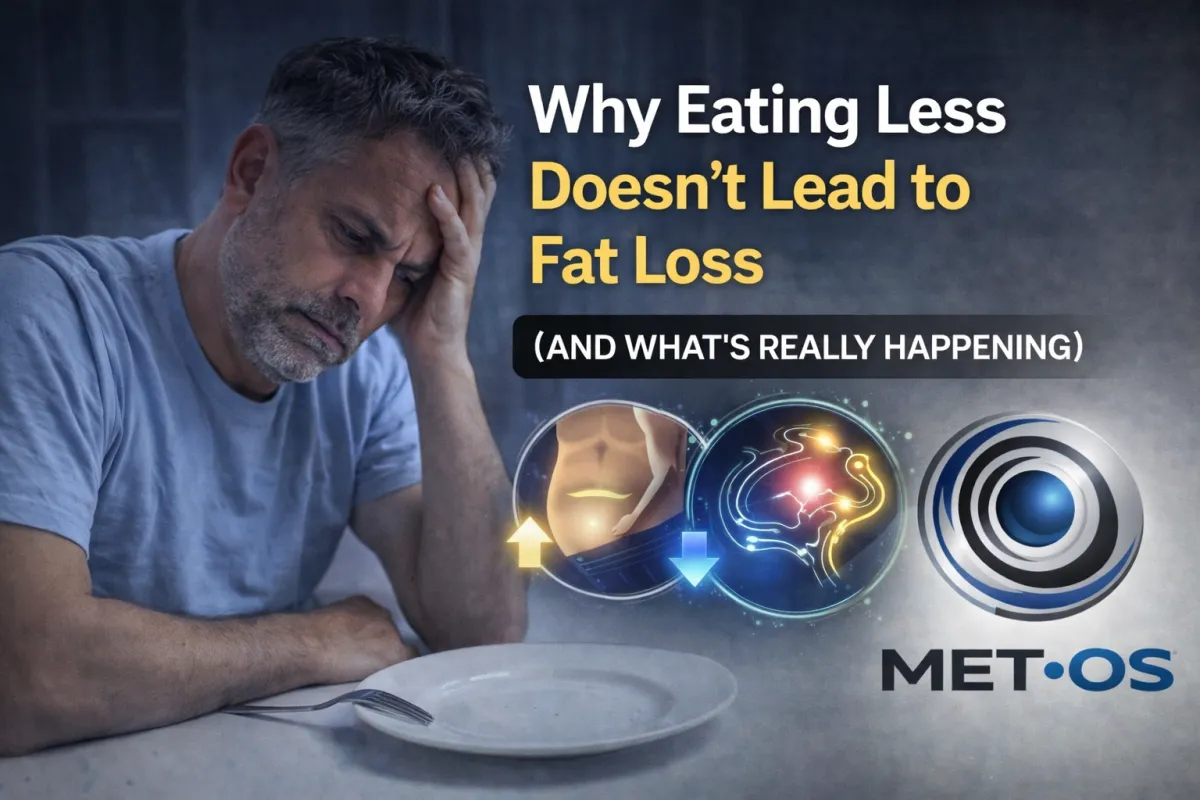
Why Eating Less Doesn’t Always Lead to Fat Loss
Why Eating Less Doesn’t Always Lead to Fat Loss
Introduction
Most fat loss advice is built on one idea:
Eat less.
Create a calorie deficit.
Lose weight.
On paper, this makes sense.
But in reality, many men over 40 find that eating less doesn’t lead to consistent fat loss.
In some cases, it leads to the opposite.
Fat loss slows down.
Energy drops.
Results stall.
This isn’t a failure of discipline.
It’s a metabolic response.
The Problem
You reduce calories.
You clean up your diet.
You become more aware of what you’re eating.
At first, things may work.
But over time, you notice:
• fat loss slows or stops
• energy levels drop
• hunger increases
• cravings become harder to control
So you respond by eating even less.
And that’s where the cycle begins.
Explanation / Mechanism
Your body does not respond to calories in isolation.
It responds to signals.
When food intake drops too low, the body may interpret this as a threat.
In response, it begins to adapt by:
• reducing energy output
• conserving fuel
• increasing hunger signals
• slowing metabolic processes
This is a form of metabolic protection.
The goal is not fat loss.
The goal is survival.
Key Concepts
1. The Body Adapts to Lower Intake
When you consistently eat less, your body becomes more efficient.
This means:
• fewer calories burned at rest
• reduced spontaneous movement
• lower overall energy expenditure
What worked at the beginning stops working over time.
2. Hormonal Signaling Changes
Calorie restriction can influence key hormones:
• leptin (satiety) may decrease
• ghrelin (hunger) may increase
• cortisol (stress) may rise
This can lead to:
• increased hunger
• stronger cravings
• easier fat storage
The system becomes harder to regulate.
3. Fat-Burning Efficiency Decreases
Fat loss requires access to stored energy.
But when intake is too low for too long:
• the body may reduce fat oxidation
• it becomes more protective of fat stores
• energy becomes harder to access
This creates resistance to fat loss.
4. Recovery Is Compromised
Eating less can also impact recovery.
This may result in:
• poor sleep quality
• slower muscle repair
• increased fatigue
When recovery drops, so does metabolic performance.
5. Metabolic Protection Mode Is Triggered
When multiple stress signals combine—low food, high stress, poor sleep—the body may enter metabolic protection mode.
In this state:
• fat loss slows
• energy drops
• fat storage increases
This is not a malfunction.
It is a protective adaptation.
Practical Insight
If eating less isn’t working, eating even less is rarely the solution.
More restriction often leads to:
• more stress
• lower energy
• greater resistance
Instead, the goal is to:
• stabilize intake
• support energy production
• improve hormonal signaling
• restore recovery
Fat loss becomes easier when the system is functioning properly.
The MOS Perspective
Within the Metabolic Operating System (MOS), fat loss is not driven by calorie restriction alone.
It is driven by system function.
Eating less without supporting the system can impair:
• Fuel Utilization
• Hormonal Signaling
• Metabolic Flexibility
• Recovery & Energy
When these switches are disrupted, the body shifts into protection mode.
MOS focuses on restoring these systems in sequence.
So fat loss happens naturally.
Not forcefully.
Why More Restriction Can Backfire
This is where most people get stuck.
They believe:
“If I’m not losing fat, I must not be trying hard enough.”
So they:
• cut calories further
• skip meals
• increase training
But this often increases stress on the body.
Which reinforces the same metabolic patterns blocking fat loss.
What To Do Instead
If you feel like eating less is no longer working, it’s time to understand why.
👉 Take The Metabolic Self Test
It will show you:
• which metabolic systems are impaired
• why fat loss has stalled
• what your body actually needs
This is the first step to restoring your metabolism.
Final Thoughts
Eating less can work in the short term.
But long-term fat loss is not just about calories.
It’s about how your body responds to them.
When the system becomes impaired, more restriction does not create better results.
It creates resistance.
Fat loss doesn’t come from eating less.
It comes from restoring the systems that allow your body to use energy properly.


