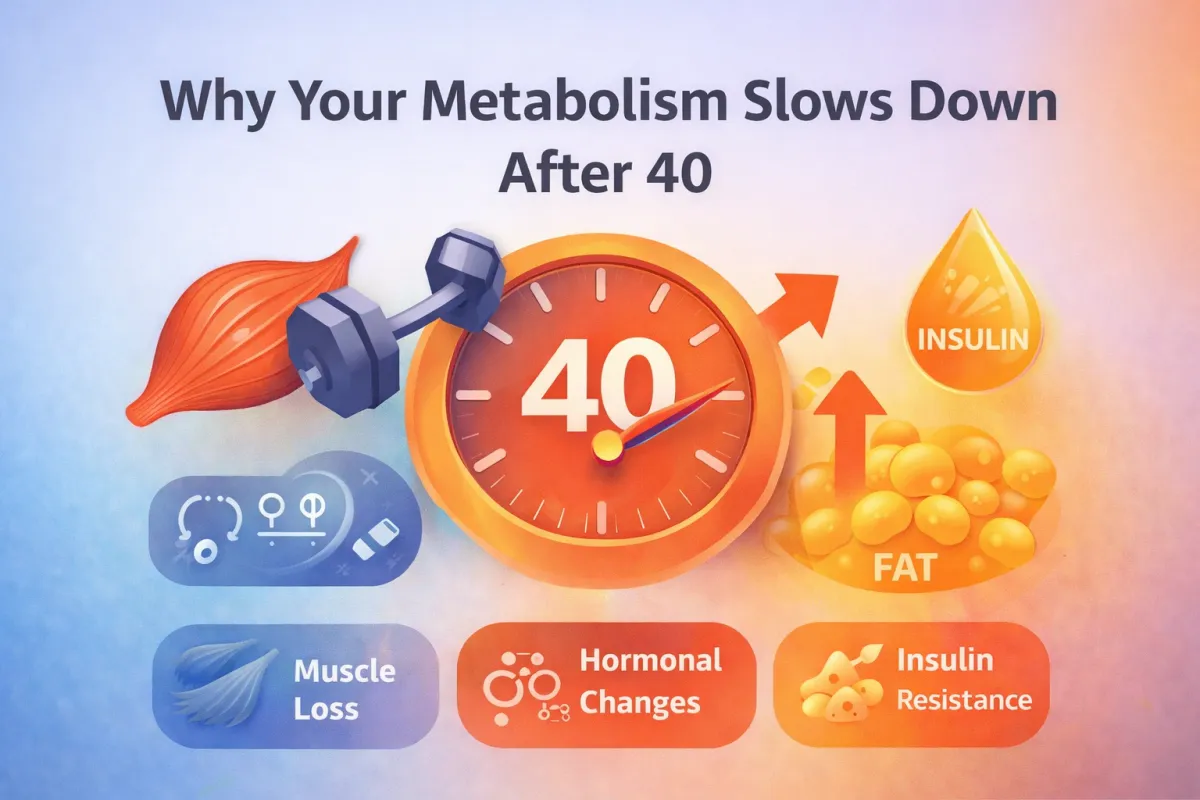
Why Your Metabolism Slows Down After 40
Why Your Metabolism Slows Down After 40
Introduction
Many people notice that losing weight becomes significantly harder after the age of 40. Diets that once worked suddenly stop producing results, energy levels decline, and stubborn belly fat begins to accumulate.
While many assume this happens because of a “slow metabolism,” the reality is more complex. Changes in muscle mass, hormones, insulin sensitivity, and lifestyle factors all contribute to metabolic changes that affect how the body burns energy and stores fat.
Understanding these changes is the first step toward restoring metabolic function.
The Role of Muscle Mass
One of the biggest drivers of metabolic change with age is the gradual loss of muscle mass.
Beginning in early adulthood, people naturally lose small amounts of muscle each decade. Because muscle tissue burns more calories than fat, even at rest, this loss can reduce the number of calories the body uses each day.
When muscle mass decreases, the body’s energy expenditure drops, which means the same eating habits that once maintained weight may now lead to fat gain.
This process is often accelerated by lower levels of physical activity and reduced resistance training.
Hormonal Changes
Hormones play a major role in regulating metabolism, appetite, fat storage, and energy levels.
After the age of 40, several hormonal systems begin to shift:
Testosterone levels gradually decline in men.
Estrogen and progesterone levels fluctuate and decline during perimenopause and menopause.
Thyroid hormone production can change with age.
Growth hormone levels decrease over time.
These hormonal shifts can affect how the body regulates energy and where fat is stored. Changes in hormones can also reduce insulin sensitivity, making it easier for the body to store fat rather than burn it.
Insulin Resistance
Another common metabolic change after 40 is reduced insulin sensitivity.
Insulin is the hormone responsible for moving glucose from the bloodstream into cells so it can be used for energy. When cells become resistant to insulin, the body must produce more insulin to regulate blood sugar levels.
Higher insulin levels can promote fat storage and make fat loss more difficult.
Many people interpret these changes as a slow metabolism, when in reality the underlying issue is impaired metabolic regulation.
Lifestyle and Stress
Lifestyle factors also play an important role in metabolic health.
Chronic stress can increase cortisol levels, a hormone that influences energy regulation and fat storage. Poor sleep, reduced physical activity, and highly processed diets can further disrupt metabolic balance.
Over time, these factors can create a metabolic environment where the body becomes more efficient at storing energy and less efficient at burning fat.
A Metabolic Systems Perspective
The Metabolic Operating System framework explains these challenges through four metabolic systems that regulate energy production and fat metabolism:
Fuel Utilization
Hormonal Signals
Metabolic Flexibility
Recovery and Energy Regulation
When these systems are functioning properly, the body can efficiently regulate energy and maintain metabolic balance.
When one or more of these systems become impaired, the body may shift into a protective state where fat loss slows and energy levels decline.
Evaluating Your Metabolism
Because multiple systems influence metabolism, simply eating fewer calories is rarely the most effective long-term solution.
Understanding which metabolic systems may be impaired is often the key to restoring metabolic function.
The MOS assessment helps identify the metabolic signals that may be affecting fat loss and energy levels.
👉 Take the Metabolic Self Test
Conclusion
Metabolism does not suddenly stop working after 40, but several biological changes can make weight management more challenging.
Loss of muscle mass, hormonal shifts, insulin resistance, and lifestyle factors all influence how the body produces and uses energy.
By understanding how these systems interact, it becomes possible to address the root causes of metabolic slowdown and restore healthy metabolic function.


