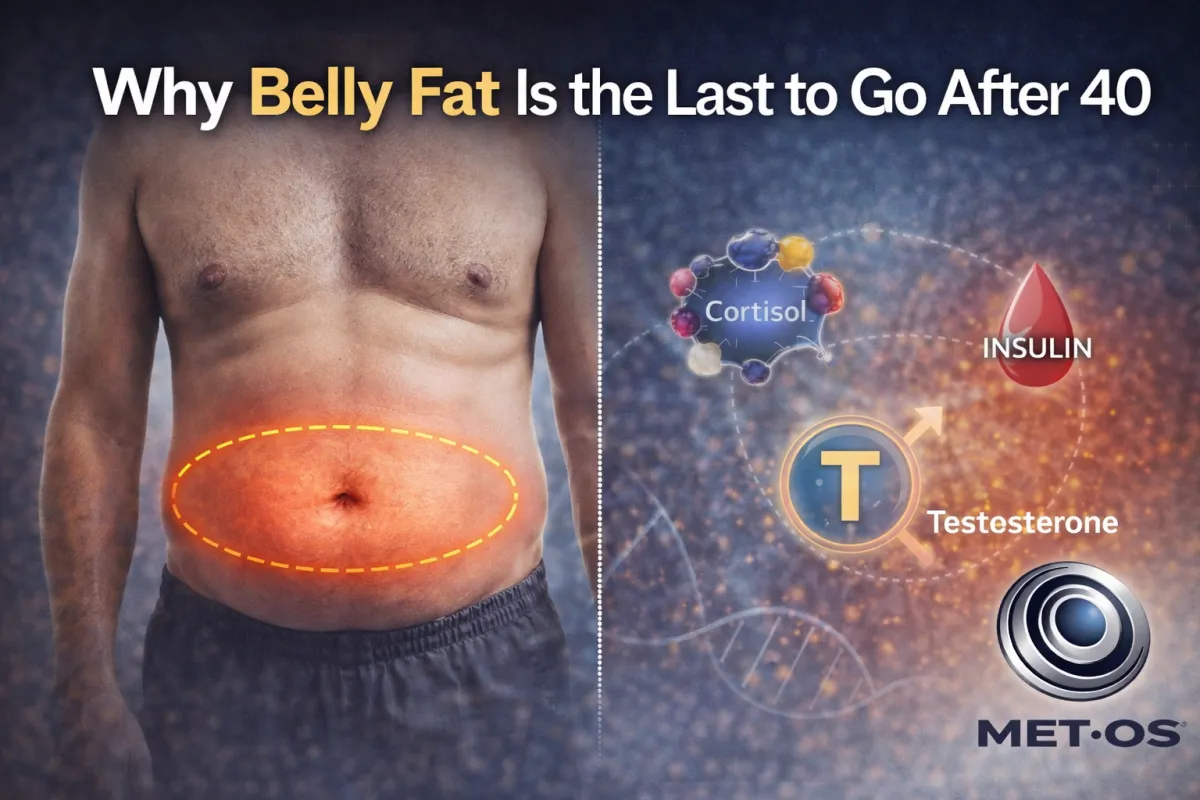
Why Belly Fat Is the Last to Go After 40
Why Belly Fat Is the Last to Go After 40
Introduction
If you are over 40 and trying to lose fat, you have probably noticed something frustrating.
Your weight might drop. Your face might lean out. Your arms might tighten.
But your belly fat stays.
This is not random. And it is not because you are not trying hard enough.
Belly fat is the last to go after 40 because your metabolism is no longer responding the way it used to. The signals that control fat burning have changed.
Until those signals are restored, your body will continue to protect belly fat no matter how hard you push.
Belly Fat Is Not Just Fat — It Is a Signal Problem
Most people think belly fat is just stored calories.
It is not.
Belly fat is strongly tied to your metabolic signals, especially:
Insulin regulation
Cortisol (stress hormone)
Blood sugar stability
Hormonal signaling (testosterone, thyroid)
When these signals are off, your body shifts into storage mode, not fat-burning mode.
This is why you can eat less, train harder, and still not lose belly fat.
After 40, Your Body Prioritizes Survival Over Fat Loss
As you age, your metabolism becomes more protective.
It becomes more sensitive to:
Stress
Undereating
Overtraining
Blood sugar swings
When these stress signals increase, your body elevates cortisol.
Cortisol tells your body one thing:
“Hold onto energy. Do not burn it.”
And where does the body prefer to store that energy?
The abdomen.
This is why belly fat becomes more stubborn after 40.
Insulin Resistance Makes Belly Fat Stick
Another major reason belly fat is the last to go is insulin resistance.
When insulin is elevated or not working properly:
Fat burning is reduced
Fat storage increases
Energy becomes unstable
Your body loses the ability to efficiently access stored fat.
Instead of burning fat, it stays dependent on incoming fuel.
This is why stabilizing insulin is critical.
👉 If you want a deeper breakdown, read:
What Is Insulin Resistance (And Why It Matters)
Blood Sugar Instability Locks Belly Fat In Place
When your blood sugar is unstable, your body constantly shifts between spikes and crashes.
This creates:
Increased cravings
Energy dips
More frequent eating
Elevated insulin
This cycle blocks fat loss, especially around the belly.
The body cannot burn fat effectively when it is constantly trying to stabilize blood sugar.
👉 Related:
Why Blood Sugar Control Is Critical for Fat Loss
Why Dieting Makes Belly Fat Worse
This is where most men go wrong.
They try to solve belly fat by:
Cutting calories
Skipping meals
Increasing cardio
Training harder
These strategies increase stress on the body.
And stress leads to higher cortisol.
And higher cortisol leads to more belly fat retention.
So instead of losing belly fat, they reinforce the exact signal that protects it.
The Real Reason Belly Fat Is the Last to Go
Belly fat is not stubborn.
It is protected.
It is the last to go because your body does not feel safe enough to release it.
Until your metabolism stabilizes, your body will prioritize holding onto that fat as a backup energy source.
How the Metabolic Operating System Solves This
Inside the Metabolic Operating System (MOS), we do not try to force fat loss.
We restore the signals that allow fat loss to happen automatically.
This includes:
Structured meal timing (4×4 system)
Blood sugar stabilization
Insulin regulation
Stress and recovery alignment
As these signals improve, the body shifts out of storage mode.
And when that happens, belly fat starts to move.
Not first.
But finally.
Final Takeaway
If belly fat is the last thing to go, it is not because you are failing.
It is because your metabolism is protecting it.
The solution is not more restriction or more intensity.
The solution is restoring the metabolic signals that tell your body it is safe to let it go.
Your next Steps:
If you want to understand exactly which metabolic signals are blocking your fat loss:
👉 Take the Metabolic Self Test
It takes two minutes and shows you exactly what is holding your metabolism back.


