Why Traditional Diets Fail Long Term
Why Traditional Diets Fail Long Term
Introduction
Most diets work in the beginning.
But very few work long term.
This is one of the most common frustrations for men over 40.
They follow the plan, they see some results, and then everything slows down or stops.
Eventually, the weight comes back.
This is not a failure of discipline.
It is a failure of the approach.
The Problem
Traditional diets focus on reducing calories.
They are built around restriction, control, and short-term outcomes.
While this can create initial weight loss, it does not address how the metabolism is functioning.
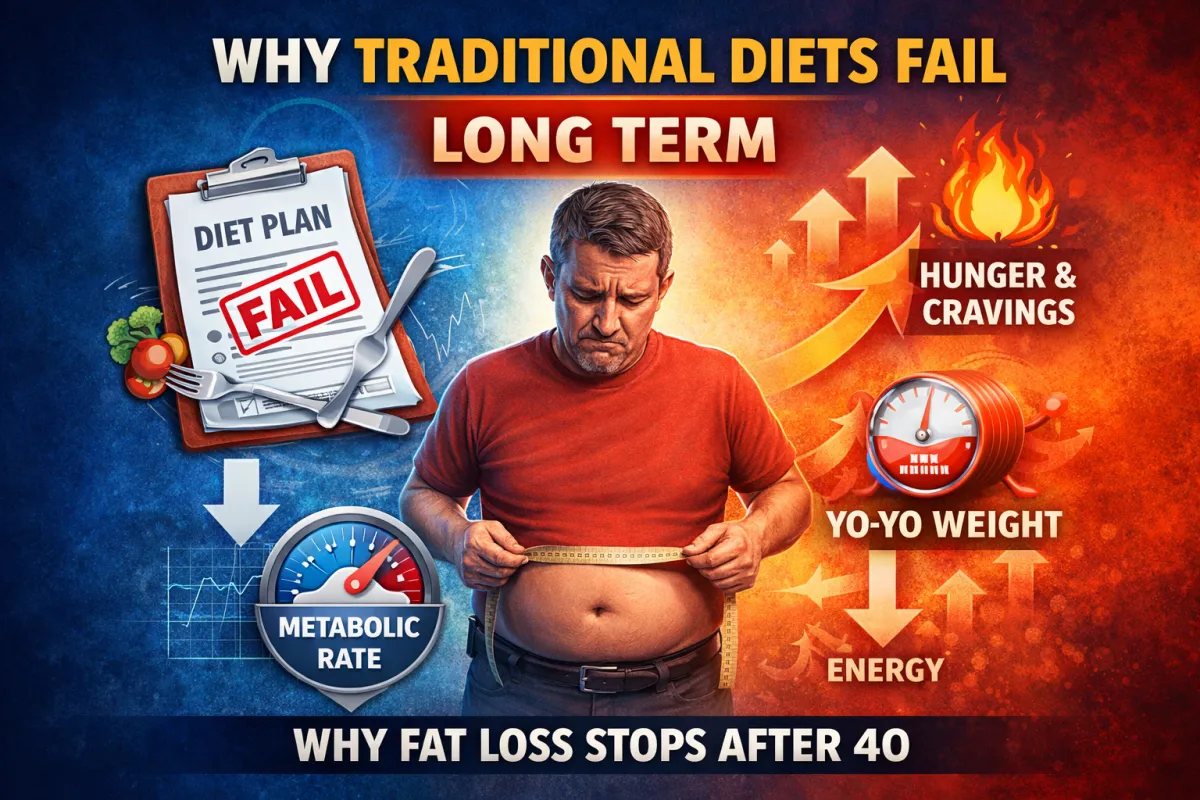
Over time, the body adapts.
This adaptation is what causes diets to fail.
How the Body Responds to Dieting
When calorie intake is reduced, the body does not simply lose fat.
It adjusts.
Energy output decreases.
Hunger signals increase.
Hormonal balance shifts.
This is the body’s way of protecting itself.
It is trying to maintain stability and prevent perceived energy loss.
Why Fat Loss Slows Down
As the body adapts to a lower calorie intake, fat loss becomes less efficient.
This leads to:
Plateaus
Reduced energy levels
Increased cravings
Loss of motivation
👉 Related: What Causes Fat Loss Plateaus
At this point, most people try to push harder.
But pushing harder often creates more resistance.
The Role of Metabolic Signals
Fat loss is not just about calories.
It is about metabolic signals.
These include:
Hormones
Blood sugar regulation
Energy balance
Recovery capacity
When these signals are disrupted, the body becomes less responsive.
This is why diets that focus only on food intake fail to produce lasting results.
Key Concepts
Short-term weight loss is not the same as long-term fat loss.
The body adapts to calorie restriction over time.
Hormones and metabolic signals control fat loss.
More restriction often leads to more resistance.
Sustainability requires stability, not intensity.
Why Restriction Creates Instability
When diets are too restrictive, they create stress within the body.
This can lead to:
Elevated cortisol
Disrupted blood sugar
Reduced recovery
👉 Related: How Stress and Cortisol Can Cause Weight Gain
These factors make fat loss more difficult, not easier.
The Cycle of Dieting
Many people experience the same pattern:
They lose weight quickly.
Progress slows down.
They increase restriction.
They regain the weight.
This cycle repeats.
The problem is not the person.
The problem is the system.
The MOS Perspective
The Metabolic Operating System does not focus on restriction.
It focuses on restoring metabolic function.
This includes:
Stabilizing blood sugar
Improving hormonal signaling
Supporting recovery
Creating consistent structure
When these elements are in place, fat loss becomes more sustainable.
Practical Insight
Instead of asking “How can I eat less?”
The better question is:
“How can I improve how my body processes energy?”
This shift in thinking changes everything.
Your Next Steps
If you have struggled with diets in the past, the issue may not be effort.
It may be metabolic function.
👉 Take the Metabolic Self Test
This will help you understand what is happening inside your metabolism and what to do next.
Final Thoughts
Traditional diets fail because they do not address the underlying systems that control fat loss.
They focus on short-term restriction instead of long-term stability.
When metabolic function improves, fat loss becomes more consistent and sustainable.
This is not about doing more.
It is about doing the right things in the right sequence.


