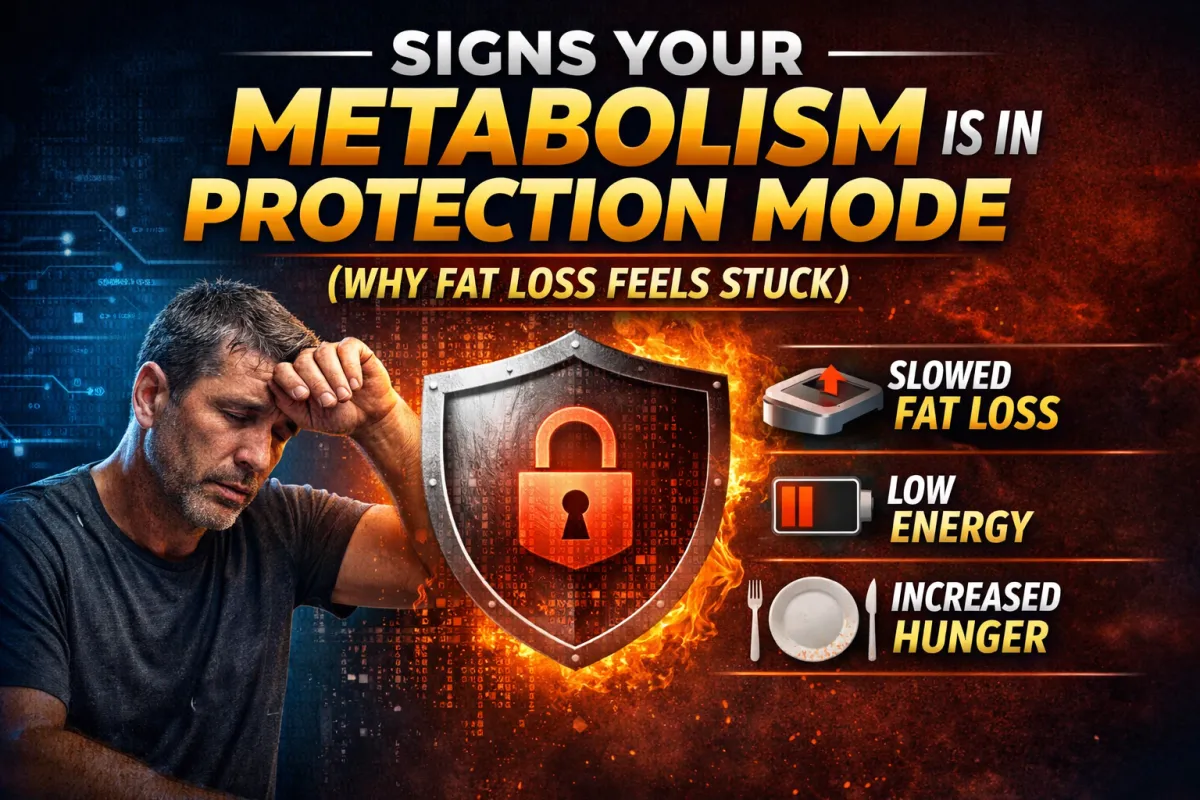
Signs Your Metabolism Is in Protection Mode (And Why Fat Loss Feels Stuck)
Signs Your Metabolism Is in Protection Mode (And Why Fat Loss Feels Stuck)
What Does “Metabolism in Protection Mode” Mean?
When your metabolism enters protection mode, your body shifts its priority away from fat loss and toward energy conservation, stability, and survival.
This is not a failure of your metabolism—it is a highly intelligent response to the signals your body has been receiving over time.
Can You Reverse Metabolic Protection Mode?
Yes, but not by pushing harder.
Metabolic protection is reversed by restoring stability, improving energy signals, and allowing your body to feel safe enough to become responsive again.
What Are the Most Common Signs?
The most common signs include stalled fat loss, inconsistent energy, increased hunger, poor recovery, and a growing reliance on stimulants like caffeine just to maintain normal function.
Introduction
If you feel like your body is working against you, there is a reason.
Many men over 40 reach a point where fat loss no longer responds to effort in the way it once did, and what used to feel predictable now feels frustratingly inconsistent.
You may find yourself eating less, training harder, and trying to stay disciplined, yet the results either slow down or stop completely.
This is often misunderstood as a lack of discipline or effort.
In reality, it is much more precise than that.
Your metabolism has shifted into protection mode.
What Protection Mode Actually Means
Protection mode is not a condition—it is a response.
When your body detects ongoing stress, inconsistent energy intake, poor recovery, or repeated cycles of restriction, it begins to adjust in order to preserve stability.
Instead of prioritizing fat loss, your body starts prioritizing survival.
This means conserving energy, reducing output, and becoming more resistant to change.
👉 “Why Your Metabolism Slows Down After 40 (And How to Fix It)”
Why This Happens After 40
Over time, your body accumulates signals.
These signals are not dramatic on their own, but over years they begin to shape how your metabolism behaves.
Periods of dieting, inconsistent meal timing, high stress, poor sleep, and declining muscle mass all contribute to an environment where your body no longer feels stable.
As a result, it adapts.
Not by shutting down, but by becoming more protective.
Sign #1: Fat Loss Has Stalled (Despite Effort)
One of the clearest indicators of protection mode is when fat loss slows down or stops completely, even though your effort remains high or has increased.
You may be doing more than ever before, yet your body no longer responds in a predictable way.
This is not because fat loss is impossible.
It is because your body is no longer willing to prioritize it.
Sign #2: Your Energy Feels Inconsistent Throughout the Day
Energy instability is one of the earliest signals that your metabolism is under stress.
You may feel good at certain times, but then experience noticeable drops in energy that make it difficult to stay focused, productive, or engaged.
These fluctuations are often tied to unstable blood sugar and inconsistent energy availability, both of which signal to your body that resources are uncertain.
👉 “Why Blood Sugar Control Is Critical for Fat Loss”
Sign #3: Hunger Feels Harder to Control
When your metabolism is stable, hunger is predictable and manageable.
When it is not, hunger becomes more aggressive, more frequent, and harder to ignore.
This is not simply a willpower issue.
It is your body attempting to correct what it perceives as an energy deficit or imbalance.
Sign #4: You Rely on Caffeine to Function
Caffeine can be useful, but when it becomes necessary just to feel normal, it is often masking underlying instability.
If you find yourself needing multiple cups of coffee to get through the day, or using stimulants to push through fatigue, this is a strong indication that your metabolism is not producing consistent energy on its own.
Sign #5: Workouts Feel Harder Than They Should
Training should feel productive, not draining.
When your metabolism is in protection mode, workouts often feel more difficult, recovery takes longer, and performance may decline even if your effort remains high.
This is because your body is not in a position to support additional stress.
Instead, it is trying to conserve energy wherever possible.
Sign #6: Sleep and Recovery Are Inconsistent
Sleep is one of the clearest reflections of metabolic stability.
When your metabolism is under stress, falling asleep may become more difficult, staying asleep may become inconsistent, and recovery from both training and daily stress becomes less effective.
Over time, this compounds the problem, reinforcing the protective state.
Why Pushing Harder Makes It Worse
The natural reaction when fat loss stalls is to increase effort.
Eat less. Train more. Push harder.
But when your metabolism is already in a protective state, these actions often deepen the problem.
Instead of improving results, they increase stress signals, reinforce instability, and push your body further into conservation mode.
👉 “Why Eating Less Doesn’t Work After 40”
What Your Body Actually Needs Instead
Your body does not need more pressure.
It needs better signals.
This means creating an environment where energy is consistent, stress is managed, and recovery is supported.
This is where structured nutrition becomes critical.
Instead of random eating patterns or reactive decisions, your body needs predictable inputs that it can trust.
Inside the MOS framework, this is where the 4x4 structure becomes foundational.
From Protection Mode to Responsiveness
The goal is not to force fat loss.
The goal is to restore responsiveness.
When your metabolism begins to trust the signals it is receiving, it becomes more willing to release stored energy instead of holding onto it.
Fat loss is not something you chase.
It is something that happens when your body is no longer trying to protect you.
Why This Matters for Fat Loss After 40
Fat loss after 40 is not about effort—it is about alignment.
If your metabolism is stable, fat loss becomes predictable.
If your metabolism is in protection mode, fat loss becomes inconsistent and frustrating.
Understanding this difference changes everything.
Final Thoughts
Your metabolism is not broken.
It is responding exactly the way it was designed to.
Protection mode is not the problem.
It is the signal.
When you learn how to respond to that signal correctly, everything begins to change.
Next Step
If you recognize these signs in your own body:
👉 Take the Metabolic Self-Test
This will show you exactly which metabolic signals are off and what needs to be restored first.


