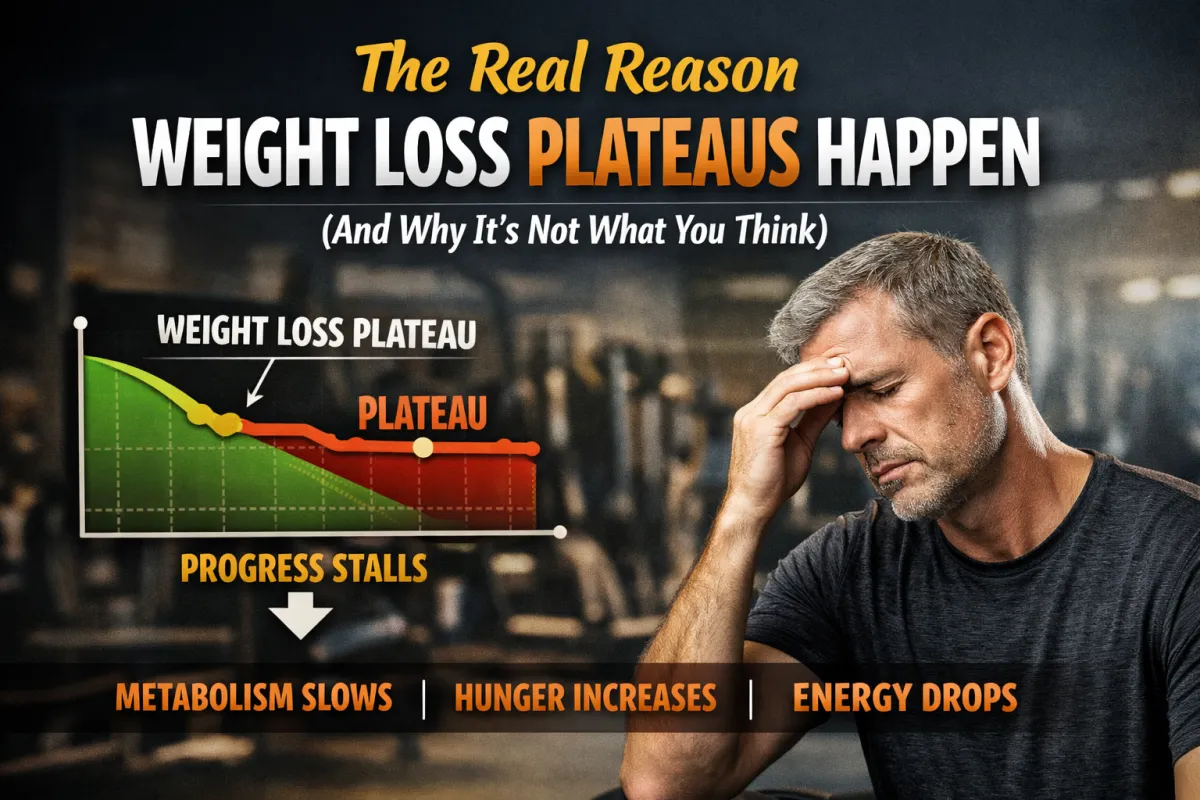
The Real Reason Weight Loss Plateaus Happen
The Real Reason Weight Loss Plateaus Happen
Introduction
If your fat loss has stalled, it is not because you are doing something wrong.
Weight loss plateaus are one of the most common frustrations, especially for men over 40.
But a plateau is not a failure.
It is a signal.
Your metabolism has stopped responding the way it did before.
What Is a Weight Loss Plateau
A weight loss plateau occurs when fat loss slows down or stops despite continued effort.
This often happens after an initial period of progress.
At first, results come quickly.
Then they slow.
Eventually, they stop altogether.
This is not random.
It is a metabolic adaptation.
Why Plateaus Happen
Your body is designed to survive, not to lose fat.
When you reduce calories or increase output, your body senses stress.
In response, it adapts.
This adaptation includes:
reduced energy production
increased hunger signals
slower metabolic rate
Over time, your body becomes more efficient at conserving energy.
This is why fat loss stops.
The Role of Metabolic Adaptation
Metabolic adaptation is your body’s way of protecting itself.
When energy intake drops or stress increases, the body shifts into conservation mode.
Instead of releasing fat, it begins to hold onto it.
This is why pushing harder often backfires.
More restriction creates more stress.
More stress reinforces the plateau.
👉 “Why Eating Less Doesn’t Lead to Fat Loss After 40”
Why Eating Less Doesn’t Fix It
Most people respond to a plateau by eating less.
This feels logical.
But it increases the exact signals that caused the plateau.
Lower intake leads to:
lower energy availability
higher stress
greater metabolic slowdown
This makes fat loss even more difficult.
The Connection to Blood Sugar and Energy
Stable energy is required for fat loss.
When blood sugar is unstable, energy becomes inconsistent.
This leads to:
energy crashes
increased hunger
reduced fat-burning efficiency
👉 “Why Blood Sugar Control Is Critical for Fat Loss”
Signs You Are in a Plateau
Fat loss has stopped despite effort
Energy levels feel lower
Hunger has increased
Workouts feel harder
These are not signs of failure.
They are signs of metabolic adaptation.
How to Break a Plateau
Breaking a plateau is not about doing more.
It is about restoring stability.
This includes:
consistent meal timing
adequate energy intake
reducing stress
supporting recovery
When your metabolism feels stable, it becomes more willing to release fat.
Why This Matters for Fat Loss
Fat loss requires a functioning metabolism.
If your body is conserving energy, it will not prioritize fat loss.
When stability is restored, fat loss becomes more accessible.
Final Thoughts
A weight loss plateau is not a problem to fight.
It is a signal to interpret.
Your metabolism has adapted to the inputs you are giving it.
When you change the signals, your metabolism responds.
Next Step
If your fat loss has stalled:
👉 Take the Metabolic Self-Test
This will show you exactly what is blocking your metabolism.


