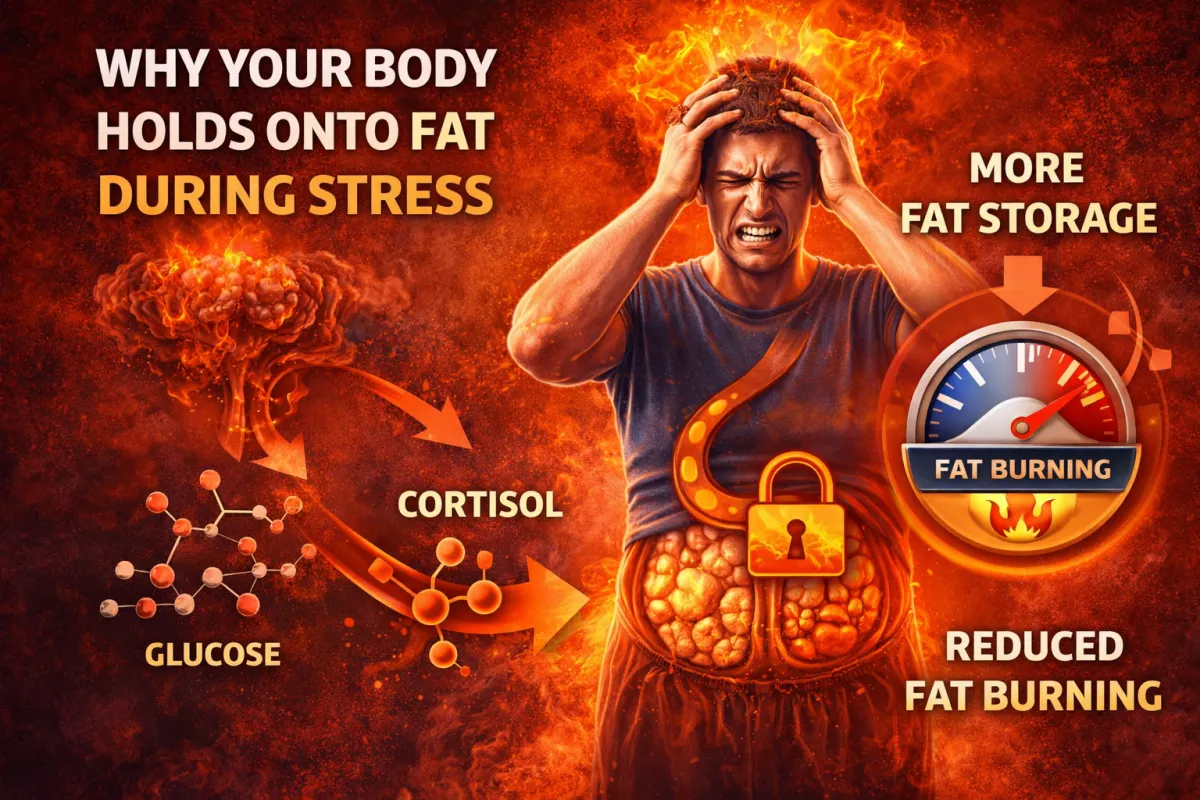
Why Your Body Holds Onto Fat During Stress
Why Your Body Holds Onto Fat During Stress
When the body is under stress, it increases cortisol levels, which can reduce fat burning and increase fat storage—especially around the abdomen. Chronic stress signals the body to conserve energy, making fat loss more difficult even with diet and exercise.
Introduction
Stress does more than affect how you feel.
It directly affects how your body stores and burns fat.
For many men over 40, stress is one of the primary reasons fat loss becomes difficult.
And most people underestimate its impact.
The Problem
When fat loss stalls, people often focus on food or exercise.
They rarely consider stress as a major factor.
However, stress changes how the metabolism functions.
And when stress is elevated, the body becomes more protective.
The Role of Cortisol
Cortisol is the body’s primary stress hormone.
It is released in response to physical, mental, and emotional stress.
In short bursts, cortisol is helpful.
But when it remains elevated, it begins to affect fat storage.
How Cortisol Affects Fat Loss
When cortisol is elevated:
The body prioritizes survival
Energy is conserved
Fat burning is reduced
At the same time, cortisol increases the likelihood of fat storage, particularly around the abdominal area.
This is why stress is often linked to belly fat.
Stress and Metabolic Protection
When the body perceives stress, it shifts into protection mode.
This includes:
Holding onto stored energy
Reducing energy output
Increasing hunger signals
From a biological perspective, this makes sense.
The body is preparing for uncertainty.
But in a modern environment, this response can become chronic.
Why Effort Backfires
Many people respond to stress by increasing effort.
They eat less.
They train harder.
They push themselves further.
But this often increases stress levels even more.
This reinforces the same hormonal environment that blocks fat loss.
👉 Related: Why Traditional Diets Fail Long Term
The Connection to Blood Sugar
Stress also affects blood sugar.
Cortisol can increase blood sugar levels, which then requires insulin to regulate.
This creates:
More insulin activity
Reduced fat burning
Greater metabolic instability
👉 Related: Why Blood Sugar Control Is Critical for Fat Loss
Key Concepts
Stress directly impacts fat storage.
Cortisol reduces fat-burning efficiency.
Chronic stress leads to metabolic protection.
More effort often increases stress and slows fat loss.
Practical Insight
Managing stress is not about eliminating it completely.
It is about reducing unnecessary stress signals.
This includes:
Consistent routines
Adequate recovery
Balanced nutrition
Sleep quality
These factors help bring cortisol levels into a more stable range.
The MOS Perspective
Within the Metabolic Operating System, this falls under Recovery and Stress (Switch 3).
If this system is not functioning properly, fat loss becomes difficult regardless of other factors.
The body will not release fat when it does not feel safe.
Your Next Steps
If your fat loss has stalled and your stress levels are high…
these two things are likely connected.
👉 Take the Metabolic Self Test
It will help you identify which signals are affecting your metabolism.
Final Thoughts
Fat loss is not just a physical process.
It is a biological response to the environment your body perceives.
When stress is high, the body becomes protective.
When stress is managed, the body becomes more responsive.
Understanding this connection is key to making fat loss sustainable.
Does stress make it harder to lose fat?
Yes. Stress increases cortisol levels, which can reduce fat burning and increase fat storage. When stress is chronic, the body becomes more protective and less willing to release stored fat.
Why does stress cause belly fat?
Stress increases cortisol, which promotes fat storage around the abdominal area. This is part of the body’s survival response, prioritizing energy storage during perceived threats.
Can cortisol stop fat loss?
Cortisol does not completely stop fat loss, but elevated levels make it significantly harder. It increases hunger, raises blood sugar, and reduces the body’s ability to burn stored fat efficiently.


