How Insulin Affects Fat Storage (After 40)
How Insulin Affects Fat Storage (After 40)
What Does Insulin Do in the Body?
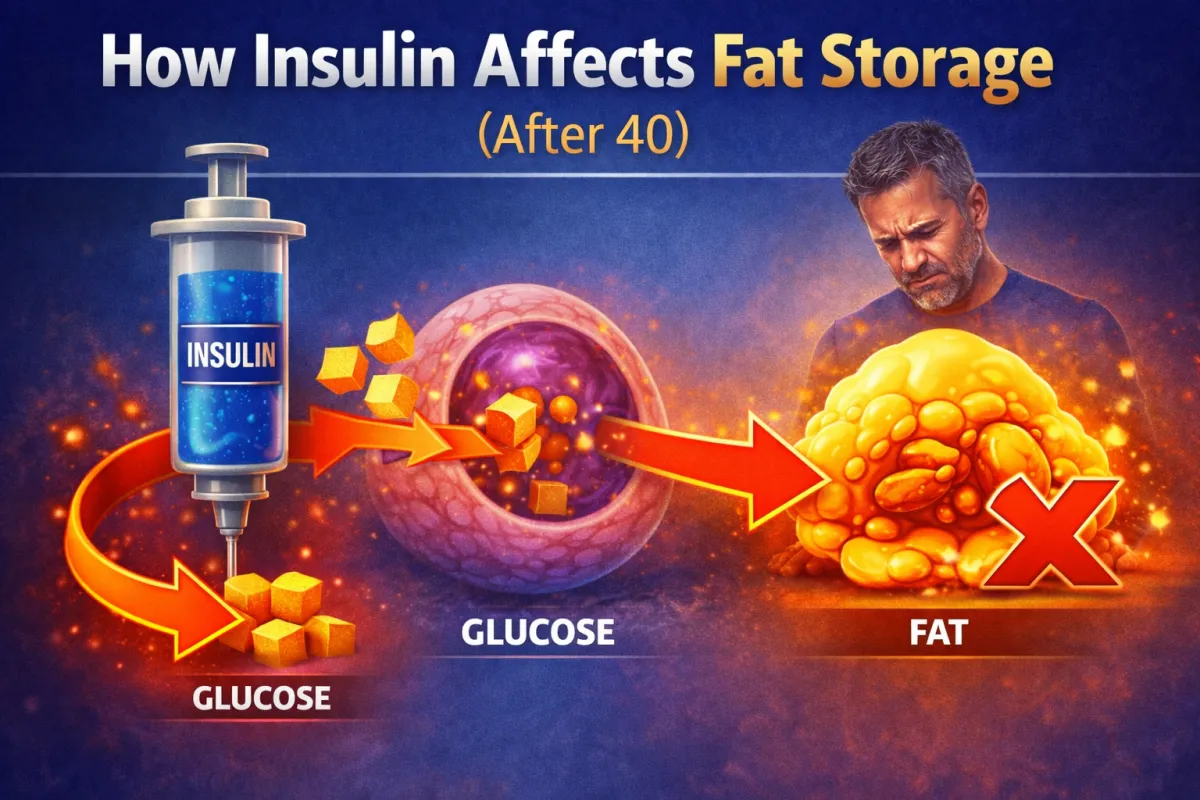
Insulin is a hormone that helps regulate blood sugar by directing nutrients into cells, but it also plays a key role in determining whether your body stores or uses energy.
Does Insulin Cause Fat Storage?
Insulin does not directly cause fat gain on its own, but consistently elevated insulin levels can reduce your body’s ability to access stored fat, which makes fat loss more difficult.
Why Does Insulin Matter More After 40?
After 40, the body becomes more sensitive to blood sugar fluctuations and insulin signaling, making it easier to store fat and harder to burn it if metabolic stability is not maintained.
Introduction
If you’ve ever heard that insulin is the hormone responsible for fat storage, you’re only hearing part of the story.
While insulin does play a role in how your body stores and uses energy, the real issue is not insulin itself—it is how your body responds to it over time.
For many men over 40, fat loss becomes more difficult not because insulin is “bad,” but because insulin signaling becomes less efficient, less predictable, and more disruptive to metabolic balance.
Understanding how insulin actually works is one of the most important steps in restoring fat loss.
What Insulin Actually Does
Every time you eat, especially carbohydrates, your blood sugar rises.
In response, your body releases insulin to help move that glucose into your cells where it can be used for energy or stored for later use.
This is a normal and necessary process.
Insulin is not the problem.
It is a critical part of how your body functions.
However, insulin also signals the body to pause fat burning temporarily while it processes incoming energy.
This becomes important when insulin levels remain elevated too often or too frequently.
When Insulin Becomes a Problem
Insulin becomes problematic when your body is exposed to frequent spikes without enough stability between them.
If you are constantly eating, snacking, or experiencing large fluctuations in blood sugar, insulin remains elevated more often than it should.
When this happens, your body has fewer opportunities to shift into fat-burning mode.
Instead of switching between using incoming energy and stored energy, your body becomes more dependent on constant input.
👉 “How the Body Switches Between Sugar and Fat for Energy”
The Link Between Insulin and Fat Storage
Insulin itself does not “cause” fat gain in isolation.
But when insulin is consistently elevated, it creates an environment where fat storage is prioritized and fat burning is reduced.
This is because your body is always focused on managing incoming energy rather than accessing stored energy.
Over time, this can lead to increased fat storage, especially when combined with unstable eating patterns or excess intake.
Why This Gets Worse After 40
As you get older, your body becomes less efficient at handling repeated spikes in blood sugar and insulin.
Years of inconsistent eating, dieting, stress, and poor recovery can lead to reduced insulin sensitivity, meaning your body requires more insulin to achieve the same effect.
This creates a cycle where:
more insulin is released
fat burning is reduced
energy becomes less stable
fat storage becomes easier
👉 “Why Your Metabolism Slows Down After 40 (And How to Fix It)”
Signs Your Insulin Response May Be Off
When insulin signaling becomes less efficient, the symptoms are often subtle at first but become more noticeable over time.
You may experience:
energy crashes after meals
frequent hunger or cravings
difficulty going longer between meals
increased belly fat
fat loss that feels slow or inconsistent
These are not just surface-level issues.
They are signals that your metabolic system is not regulating energy efficiently.
👉 “Why Can’t My Body Burn Fat? (And How to Fix It After 40)”
Why Cutting Carbs Isn’t the Full Solution
A common reaction to insulin-related fat storage is to eliminate carbohydrates entirely.
While reducing carbohydrates can temporarily lower insulin levels, it does not address the underlying issue of metabolic stability.
If your body is still experiencing stress, inconsistency, or poor signaling, removing carbs alone will not restore proper function.
The goal is not to eliminate insulin.
The goal is to improve how your body responds to it.
How to Improve Insulin Function
Improving insulin response is not about extreme restriction—it is about creating stability.
Your body needs consistent signals that allow insulin to function efficiently without being overused.
1. Stabilize Meal Timing
Consistent meal spacing allows insulin to rise and fall in a predictable pattern, giving your body time to shift between fuel sources.
2. Balance Your Meals
Including protein and fat alongside carbohydrates helps reduce sharp spikes in blood sugar and insulin.
3. Reduce Constant Snacking
Frequent eating keeps insulin elevated and limits fat-burning opportunities.
Creating structure allows your body to reset between meals.
4. Use Structured Nutrition
Inside the Metabolic Operating System, the 4x4 structure creates consistent energy patterns that improve insulin signaling over time.
👉 “How the 4x4 Meal Structure Restores Metabolic Stability”
Insulin and Metabolic Flexibility
When insulin function improves, your body becomes more capable of switching between using carbohydrates and fat for energy.
This is known as metabolic flexibility.
Instead of relying on constant input, your body can access stored energy when needed, which makes fat loss more consistent.
👉 “What Is Metabolic Flexibility (And Why It Matters for Fat Loss After 40)”
Final Thoughts
Insulin is not the enemy.
It is a tool your body uses to manage energy.
The issue arises when insulin is constantly elevated or poorly regulated, which limits your body’s ability to access stored fat.
When insulin signaling improves, your metabolism becomes more responsive, and fat loss becomes easier to achieve without extreme restriction.
Next Step
If you feel like your body is storing fat more easily or struggling to burn it:
👉 Take the Metabolic Self-Test
This will show you exactly which metabolic signals are affecting your fat loss and what needs to be restored first.
Keywords
how insulin affects fat storage
insulin and fat loss
insulin resistance after 40
why insulin causes fat gain
blood sugar and fat loss
metabolism after 40
how to fix insulin resistance
fat loss hormones


