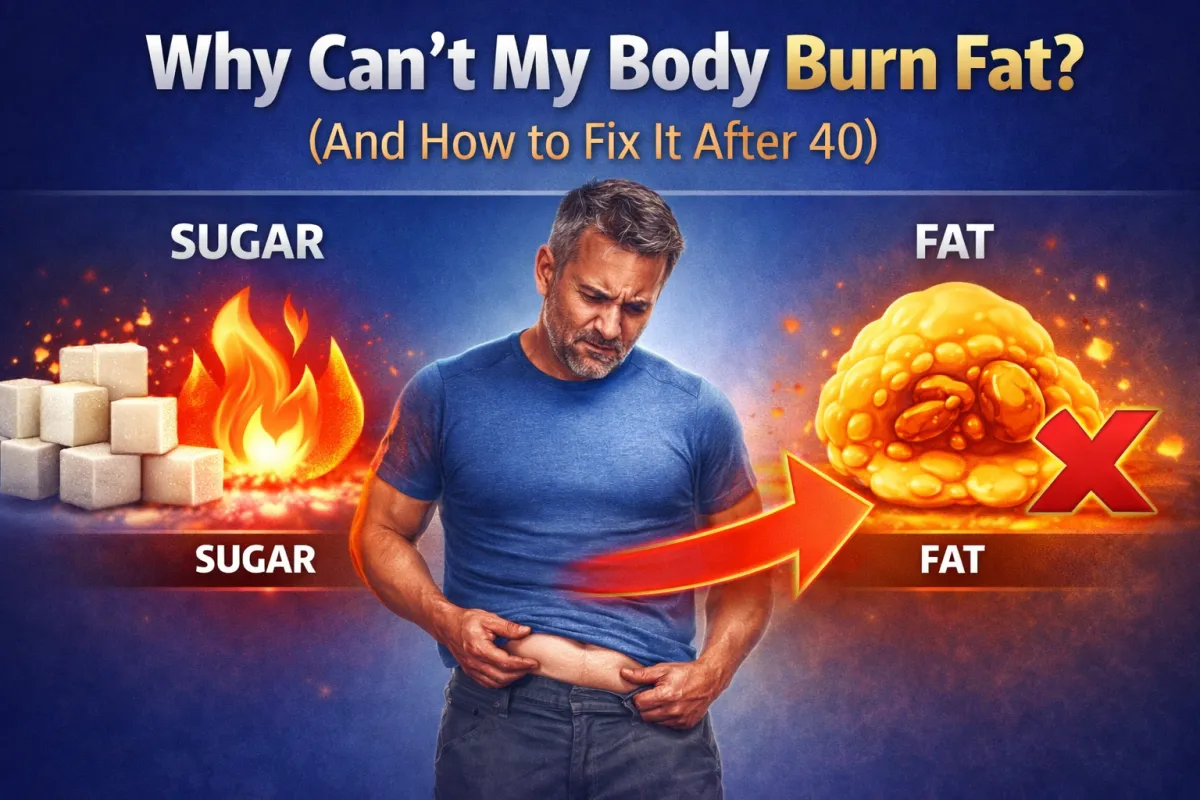
Why Can’t My Body Burn Fat? (And How to Fix It After 40)
Why Can’t My Body Burn Fat?
If your body struggles to burn fat, it is often because your metabolism is relying too heavily on sugar for energy and has lost the ability to efficiently switch to stored fat.
What Stops the Body From Burning Fat?
Fat burning is reduced when metabolic flexibility is impaired, blood sugar is unstable, or the body is under stress and prioritizing energy conservation over fat loss.
Can You Fix Fat Burning After 40?
Yes, by restoring metabolic stability through consistent nutrition, structured meals, and reduced stress signals, your body can regain its ability to use fat for energy.
Introduction
If you feel like your body refuses to burn fat no matter how hard you try, you are not alone—and more importantly, you are not broken.
Many men over 40 reach a point where fat loss becomes inconsistent, energy levels fluctuate, and the strategies that once worked no longer produce results.
This often leads to frustration and confusion, especially when effort increases but progress does not.
However, the issue is not effort.
It is function.
Your body is not unable to burn fat—it is currently not positioned to do so.
If your body cannot switch from burning sugar to burning fat, fat loss will always feel difficult.
How Fat Burning Actually Works
Your body is designed to use both carbohydrates and fat as fuel, switching between them depending on availability and demand.
After eating, your body primarily uses incoming nutrients for energy.
Between meals, during lower-intensity activity, or during rest, your body should shift toward using stored fat.
This ability to switch between fuel sources is known as metabolic flexibility.
👉 “What Is Metabolic Flexibility (And Why It Matters for Fat Loss After 40)”
When this system is working properly, fat burning happens naturally.
When it is not, fat loss becomes difficult.
Why Your Body Stops Burning Fat
Fat burning does not stop randomly—it is the result of specific signals your body has adapted to over time.
1. Your Body Is Dependent on Sugar for Energy
If your body relies heavily on frequent carbohydrate intake or experiences regular blood sugar fluctuations, it becomes less efficient at accessing stored fat.
Instead of switching between fuel sources, your body begins to depend on incoming energy, which limits fat utilization between meals.
2. Blood Sugar Is Unstable
When blood sugar rises and falls rapidly, your body is constantly shifting its focus toward stabilizing energy rather than using stored fat.
This creates a cycle where energy crashes lead to cravings, and cravings lead to more frequent eating, which further reduces the opportunity for fat burning.
👉 “Blood Sugar and Fat Loss: What Most Men Over 40 Get Wrong”
3. Your Body Is in a Protective State
If your metabolism perceives stress—whether from dieting, under-eating, poor sleep, or excessive training—it may prioritize energy conservation over fat loss.
In this state, your body becomes more resistant to using stored energy, even when it is available.
👉 “Signs Your Metabolism Is in Protection Mode”
4. You’ve Been Eating Less for Too Long
Chronic under-eating signals to your body that energy is scarce, which leads to metabolic adaptation.
Instead of increasing fat burning, your body reduces output and becomes more conservative with energy.
👉 “Why Eating Less Doesn’t Work After 40”
Why This Becomes More Common After 40
As you get older, your metabolism becomes more sensitive to stress and inconsistency.
Years of dieting, irregular eating patterns, poor sleep, and high stress accumulate, creating an environment where your body becomes less willing to rely on stored energy.
Instead of adapting quickly, your metabolism becomes more cautious.
This is why fat burning often feels harder after 40.
👉 “Why Your Metabolism Slows Down After 40 (And How to Fix It)”
The Signs Your Body Isn’t Burning Fat Efficiently
When fat burning is impaired, the signals are often clear:
you feel hungry shortly after eating
your energy crashes between meals
you rely on caffeine to maintain focus
fat loss feels slow or inconsistent
you struggle to go longer periods without eating
These are not random issues.
They are indicators that your metabolism is not accessing stored fat effectively.
Why Forcing Fat Loss Doesn’t Work
A common reaction to stalled fat loss is to increase effort—eat less, train harder, or cut more calories.
However, when your body is already struggling to burn fat, these strategies often reinforce the problem by increasing stress and reducing metabolic stability.
Fat loss cannot be forced indefinitely.
It must be supported.
How to Restore Fat Burning
Restoring fat burning is not about pushing harder—it is about improving how your metabolism functions.
The goal is to rebuild your body’s ability to switch between fuel sources naturally.
1. Stabilize Your Energy Intake
Consistent meal timing helps your body trust that energy is available, reducing the need to conserve.
2. Improve Blood Sugar Stability
Balanced meals with adequate protein and fat support steady energy and reduce fluctuations that interfere with fat burning.
3. Reduce Stress Signals
Improving sleep, managing training intensity, and avoiding chronic restriction all help your metabolism move out of a protective state.
4. Use Structured Nutrition
Inside the Metabolic Operating System, the 4x4 structure creates a predictable rhythm of energy delivery, which helps restore metabolic stability and improve fat utilization over time.
👉 “How the 4x4 Meal Structure Restores Metabolic Stability”
From Fat Burning to Metabolic Responsiveness
The goal is not just to “burn fat.”
The goal is to become metabolically responsive, meaning your body can access stored energy when needed and maintain energy when required.
When this happens, fat loss becomes more consistent and less dependent on extreme effort.
Final Thoughts
Your body is not failing to burn fat—it is responding to the signals it has been given.
When those signals are unstable, inconsistent, or stressful, your body becomes more conservative.
When those signals are stable and predictable, your body becomes more responsive.
Fat burning is not something you force.
It is something your body allows.
Next Step
If you feel like your body isn’t burning fat the way it should:
👉 Take the Metabolic Self-Test
In just two minutes, you’ll see exactly which metabolic signals are limiting your fat loss—and what to fix first.
Keywords
why can’t my body burn fat
fat burning after 40
metabolism not burning fat
how to burn fat naturally
fat loss resistance
metabolic flexibility
slow metabolism symptoms
fat loss plateau


