Why Your Body Holds Onto Fat (Even When You’re Doing Everything Right)
Why Your Body Holds Onto Fat (Even When You’re Doing Everything Right)
Why Does My Body Hold Onto Fat?
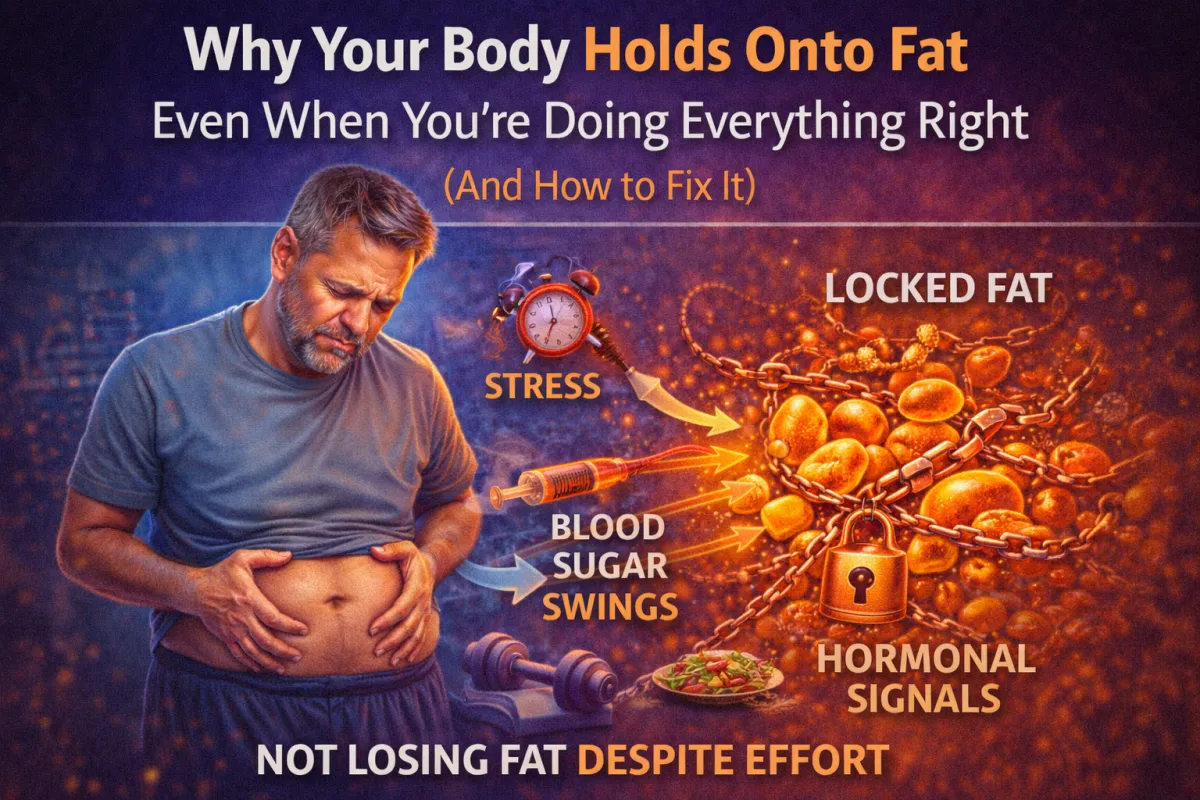
Your body holds onto fat when it perceives stress, instability, or inconsistent energy signals, which leads it to prioritize protection over fat burning.
Why Am I Not Losing Fat Even Though I’m Trying?
If your metabolism is not functioning efficiently, your body may resist fat loss despite your effort by conserving energy and reducing fat burning.
Can You Fix Stubborn Fat After 40?
Yes, by restoring metabolic stability and improving how your body responds to energy, stress, and nutrition, fat loss becomes more consistent.
Introduction
If you feel like you’re doing everything right—eating better, exercising more, trying to stay disciplined—but your body still isn’t losing fat, you’re not alone.
This is one of the most frustrating experiences for men over 40.
Because it doesn’t make sense.
Effort is high, but results are low.
And over time, it starts to feel like your body is working against you.
But it’s not.
It’s responding.
👉 Take the Metabolic Self-Test
If your body isn’t responding the way it used to, this will show you exactly which signals are affecting your fat loss.
Your Body Is Designed to Protect You
Your metabolism is not designed to prioritize fat loss.
It is designed to keep you alive.
That means when your body detects instability—whether from stress, inconsistent eating, or lack of recovery—it shifts into a more protective mode.
In that state, fat loss becomes less important than survival.
👉 This is where most men get stuck.
What Signals Tell Your Body to Hold Onto Fat
Your body doesn’t randomly store fat.
It responds to signals.
And when those signals suggest instability, fat storage becomes more likely.
1. Inconsistent Energy Intake
If your eating patterns are irregular or unpredictable, your body becomes less confident that energy is consistently available.
This leads to more conservative energy use.
2. Chronic Stress
Stress increases cortisol, which signals the body to conserve energy and prioritize fat storage.
👉 “Why Cortisol Causes Weight Gain After 40 (And How to Fix It)”
3. Blood Sugar Instability
Frequent spikes and crashes in blood sugar increase insulin and reduce fat-burning opportunities.
👉 “Why Blood Sugar Swings Cause Fat Gain (After 40)”
4. Poor Fuel Switching
If your body cannot switch between sugar and fat efficiently, it becomes more dependent on incoming energy.
👉 “How Your Body Switches Between Burning Sugar and Fat (After 40)”
Why Doing More Doesn’t Fix It
The natural response to stalled fat loss is to increase effort.
Eat less.
Train more.
Push harder.
But if your body is already under stress, this approach often makes things worse.
👉 This is not a discipline problem—it’s a signal problem.
👉 “Why Eating Less Doesn’t Work After 40”
The Role of Metabolic Protection Mode
When your body experiences ongoing stress or instability, it may enter Protection Mode.
In this state:
fat burning is reduced
energy is conserved
hunger increases
fat storage becomes easier
This is your body trying to protect you—not sabotage you.
👉 “Signs Your Metabolism Is in Protection Mode”
👉 If you feel like your body is resisting fat loss no matter what you do, take the Metabolic Self-Test to see what’s actually happening beneath the surface.
How to Get Your Body to Let Go of Fat
Fat loss becomes possible when your body feels safe enough to release stored energy.
That means improving the signals your body is receiving.
Create Consistency
Your body responds well to predictable patterns, especially with nutrition.
Reduce Stress Signals
Improving sleep and avoiding excessive restriction helps lower cortisol and improve metabolic function.
Stabilize Blood Sugar
Balanced meals reduce spikes and crashes that interfere with fat burning.
Use Structured Nutrition
Inside the Metabolic Operating System, the 4x4 structure creates stability that supports consistent fat loss over time.
👉 “How the 4x4 Meal Structure Restores Metabolic Stability”
From Resistance to Responsiveness
The goal is not to force fat loss.
The goal is to make your body responsive again.
When your metabolism becomes stable, fat loss becomes a natural outcome rather than a constant struggle.
Why This Matters After 40
As your metabolism becomes more sensitive with age, it becomes more reactive to stress and inconsistency.
This is why the same strategies that worked in the past often stop working.
👉 “Why Your Metabolism Slows Down After 40 (And How to Fix It)”
Final Thoughts
Your body is not holding onto fat because it’s broken.
It’s holding onto fat because it’s trying to protect you.
When you change the signals, your body changes its response.
If your body doesn’t feel safe, it will hold onto energy instead of using it.
Next Step
👉 Take the Metabolic Self-Test
This will show you exactly which metabolic signals are affecting your fat loss—and what to fix first.


